TwoStep CEO Caitlyn Miller on the Gap Between Shrinking Tumors and Convincing Investors
When Caitlyn Miller started her PhD, she did not want to start a company or join a startup. She wants you to know that. It's the first thing she says when we sit down to talk, and she says it with the kind of emphasis people reserve for correcting a persistent misunderstanding. "I actually adamantly did not want to," she tells me. "I thought it sounded like the most stressful, crazy job ever. I thought I'd prefer something with more stability."
She pauses. "Turns out I don't."
Miller is the CEO and co-founder of TwoStep Therapeutics, a startup working on targeted cancer therapies for solid tumors. She is 30-something, trained as a bioengineer at Stanford, and now runs a Series A-stage biotech company with a growing team and a lead drug program that she expects to enter clinical trials this year. She did her PhD and postdoc in the labs of Carolyn Bertozzi and Jennifer Cochran, collaborating closely with Ron Levy's lab as well. If you know those names, you know the weight they carry. Bertozzi won the Nobel Prize in Chemistry in 2022. Cochran is a leader in protein engineering. Levy helped develop Rituximab, one of the first monoclonal antibodies approved to treat cancer. Miller was their student, then their collaborator, and now she's the one trying to turn their shared work into something a patient can actually receive.
The particular problem TwoStep is chasing is simple to describe and miserable to solve. About 90 percent of cancers are solid tumors. But most of the tumor-targeted therapies that have worked well in the last two decades, things like CAR-T cells and many antibody-drug conjugates, only work for a fraction of patients, particularly when it comes to solid tumors. The reason has to do with targets. These therapies need something specific on the tumor's surface to latch onto, a molecular address to deliver their payload. Blood cancers tend to have reliable addresses. Solid tumors don't. The cells within a single tumor, and across different tumors in the same patient, can express totally different markers. You design a therapy to hit one target, and a chunk of the tumor dodges it. Resistance follows.
TwoStep's bet is a synthetic peptide that has the ability to bind to five different tumor-associated targets. Statistically, a patient's solid tumor will express at least one of them, and usually two or three. The company then attaches different payloads to this targeting peptide: a cytotoxic drug in one program, a radioactive metal in a radiopharmaceutical program. Step one, targeting. Step two, the payload. That's the name "TwoStep."
I bring all of this up because science is the reason the rest of the story happened at all. Miller didn't start with a desire to be a CEO and go looking for a technology to commercialize. She started with a PhD project, watched it work far better than she expected, and couldn't stop thinking about what would happen if she walked away.
"The very first time we did a mouse study, the tumors were cured," she says. "And that just kind of kept happening."
There is a version of this story that's familiar to anyone who reads about biotech: brilliant scientist has eureka moment, spins out company, raises money, changes medicine. The version Miller tells is less tidy. It involves a ten-month sprint through Stanford's Innovative Medicines Accelerator, where she was the first entrepreneur-in-residence, a willing guinea pig. It involves months of pitching venture capitalists, getting feedback, and building her network. It involves a term sheet that arrived on Halloween. And it involves a lot of tasks that have nothing to do with curing cancer: setting up a bank account, figuring out corporate insurance, learning what treasury management is and why it matters, and hiring and HR.
"You work so hard to get this company funded," she says, "and then once you get the company funded, you just have this huge new checklist of everything that you have to do, and it's things that you've never done before, and you just have to figure it out."
The initial Seed fundraising itself was the hardest part, by her account. Not the science, not the regulatory questions, not the operational busywork, not even Series A fundraising. The very first Seed round. Miller is a high-achieving Stanford PhD. Up until that point, she had, by her own description, spent most of her life being told "yes." Fundraising inverts that ratio completely. She says she was told by another female CEO to expect to pitch about 75 investors before getting a lead for the Seed round. She ended up needing about half that number, but she'd braced herself for the full gauntlet. "You kind of have to develop a thicker skin in order to survive," she says. "And if you haven't been through that before, going through that for the first time is hard."
What kept her going through it? Conviction in the data, for one. Stubbornness, for another.
In the podcast's rapid-fire segment, when asked what reading changed how she thinks, Miller doesn't name a journal article or a textbook. She points to a blog post on the website of NFX, TwoStep's lead Seed investor, by Omri Drory, a general partner at the firm, about the "intangibles" that make investors want to back a founder. Drory's argument is that the pitch deck and the data package aren't really what close a deal. What matters is whether the investor walks out of the room feeling that this person will survive the next ten years of suffering. His shorthand for the founder's job is blunt: "suffer stoically." Miller says the essay put words to something she'd felt but hadn't been able to articulate.
It's an interesting admission for someone running a company built on hard science and preclinical data. The reading, and other VC blog posts about psychology written in plain language about what the game actually is, helped her a lot through fundraising.
Miller and I also talk about gender, and she handles the topic with a kind of deliberate understatement. She doesn't want to make it the center of the conversation, and she doesn't want to ignore it either. Her point is narrow: imposter syndrome is real, it's common among women founders, and it's worth naming because pretending it doesn't exist helps nobody.
The numbers around her bear this out, even if she doesn't cite them directly. A 2025 PitchBook report found that while female-founded companies raised a record $73.6 billion in U.S. venture capital that year, much of that money pooled into a handful of massive late-stage deals, and the total number of deals had been declining for four straight years. A Founders Forum report from the same year found that women founders spent, on average, about two extra months fundraising compared to men, and were asked risk-oriented questions by investors at more than twice the rate.
Miller doesn't frame this as a structural critique. Her advice is personal: the feeling of imposter syndrome is real, it doesn't mean you're incapable, and it fades over time if you have the right people around you.
The most surprising thing Miller says in our conversation has nothing to do with cancer biology or venture capital. It comes near the end, when I ask what she would tell someone who's considering the founder path.
"Before you decide you want to start a company," she says, "really think about if you really want to start a company. It seems extremely glamorous from afar, especially whenever it works. But it can be hard. Do you want to be the one standing there holding it all together? And it's completely okay if the answer is no."
She goes further. Maybe you don't want to be the founder at all. Maybe you want to be the first employee, or the fortieth. You could want a co-founder who complements your weaknesses, or you could decide that you'd rather stay in academia, and the honest version of that choice is that you prefer writing grants to giving pitches, and that's fine.
Miller herself prefers the pitch. She frames the professor-versus-founder decision as a question of format: both jobs are about convincing someone to fund your ideas. Professors write grants and wait months for reviewer comments. Founders talk to people and get feedback the same week. "I'd much rather talk to a person about why I believe in something than write about it," she says. "But that's just my style."
She also wishes she'd gotten involved in the startup world earlier. She didn't start paying attention to it until her fifth year of graduate school, and says a second-year student with the same interests would have a head start. For those at Stanford, where the distance between a lab bench and a VC office can be measured in city blocks, the access is already there.
TwoStep is preparing to move its lead program into a clinical trial. If it works, it will be a drug that began as a PhD project in a Stanford lab and ended up in a patient. Most academic projects never get anywhere close to that. Miller knows the odds. The preclinical failure rate for biotech companies is high. The clinical failure rate is higher. And then there's commercialization.
"You just always have to be cautiously optimistic," she says, "and be aware of things that could go wrong and pivot if necessary."
When I ask what she'd be doing if TwoStep didn't exist, she goes quiet for a second. "I have no idea," she says.
She doesn't seem worried about it. She has a company to run, a dog, a husband who's also a startup CEO, and a therapy she believes in. The rest, for now, is just noise.
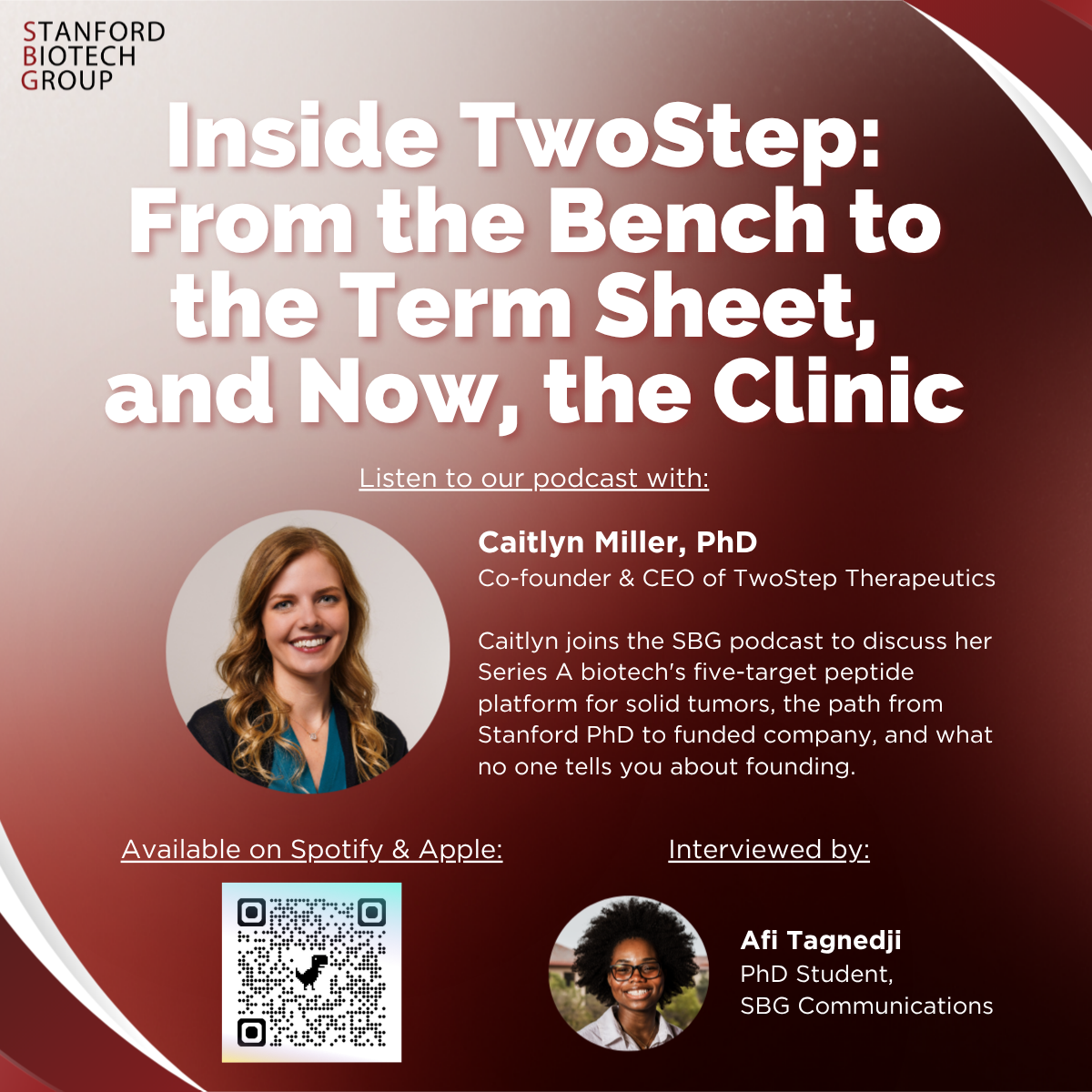
You can hear the full conversation with Caitlyn Miller on the first episode of the Stanford Biotechnology Group podcast, available now on spotify and apple podcast.